

1. Why Stablecoins Matter
Stablecoins are the silent backbone of crypto. They’re the bridge between TradFi and DeFi, powering everything from DEX liquidity to cross-border payments and on-chain treasuries.
With over $160B in total stablecoins issued, they rival the GDP of small countries.
Now, even Big Tech is circling.
Adoption is accelerating beyond crypto. Apple, Google, Airbnb, and X are exploring stablecoins for payments and rewards, signaling a shift: stablecoins are becoming part of global financial infrastructure.
2. Circle in Focus
Circle is the issuer of USDC, the second-largest stablecoin by market cap. But it’s not just a token issuer. Circle is building regulated digital dollar rails — and it’s now publicly traded on the NYSE under ticker CRCL.
Circle debuted with a $31 share price, skyrocketed to $83.23 on day one, and currently trades at $115.25, implying a ~$28B market cap.
💡 Good News for Sigil Core Investors
Sigil Core invested in Circle in July 2024, well before its public debut. On IPO day alone, this position delivered a +9% gain to the fund’s NAV — and the total return has now reached ~4x within a year.
Buying future winners in advance is one of the key ways Sigil Core generates alpha for its investors.
3. Investment Thesis
We’re bullish on stablecoins — and Circle is the only clean investable way to express that thesis on the stockmarket.
- IPO catalyst realized: Now liquid and tradable
- Regulatory edge: Circle is U.S.-regulated, unlike Tether
- Growing market: Stablecoins are eating cross-border payments
- Public market entry: ~$28B valuation with potential upside
- Anticipated regulatory tailwinds post-2024 U.S. elections, with expectations of a more favorable policy environment for crypto-native companies like Circle.
Circle is not a market leader, but it is the only investable stablecoin infra play.
4. Revenue Breakdown
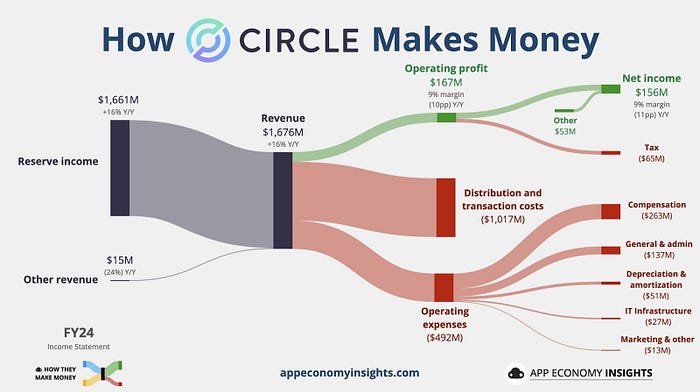
Circle earns revenue primarily through interest on reserve assets — real U.S. dollars held in custodial banks or short-term government debt.
To explain simply:
- For every 1 USDC issued, Circle holds 1 real U.S. dollar
- These dollars are stored in short-term Treasuries and repo agreements
- While held, they generate yield — driven by Federal Reserve interest rates
This forms the backbone of Circle’s business model.
Reserve Snapshot:
- ~$33B in reserves
- $11B in U.S. Treasuries (short-term)
- $16B in repo agreements (5.3%–5.4% APR)
Circle effectively lends the reserves backing USDC to the U.S. government and large institutions, earning interest in return.
- Annualized gross yield: ~$1.46B
- Net of Coinbase revenue share (~$800M/year), Circle clears at least $650–700M/year.
Circle currently charges no fees on minting/redeeming USDC — improving peg stability, but potentially reducing revenue when Fed rates decline.
5. Financials
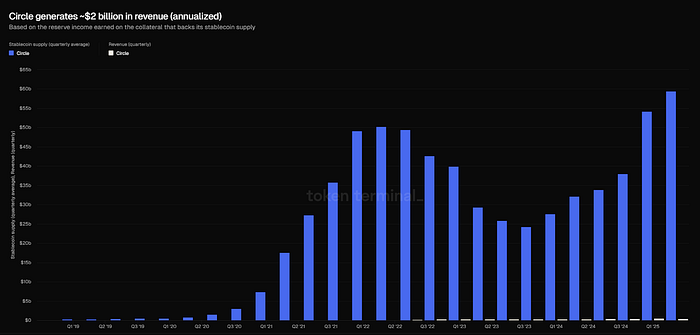
https://tokenterminal.com/explorer/studio/dashboards/98e3128c-502d-42da-8396-b7539ece9581?
FY 2024 revenue: $1.68B
FY 2024 net income: $157M
Q1 2025 revenue: $578.6M
Q1 2025 net income: $64.8M
Trailing 12 months (to Mar 2025):
Total revenue: $1.89B
Gross profit: $453M
Operating income: $207.8M
Net income: $173M
Balance Sheet Highlights:
Cash & short-term investments: ~$61.3B
Net cash per share: ~$830
Debt: Minimal (~$53M)
6. USDC Volume Trends
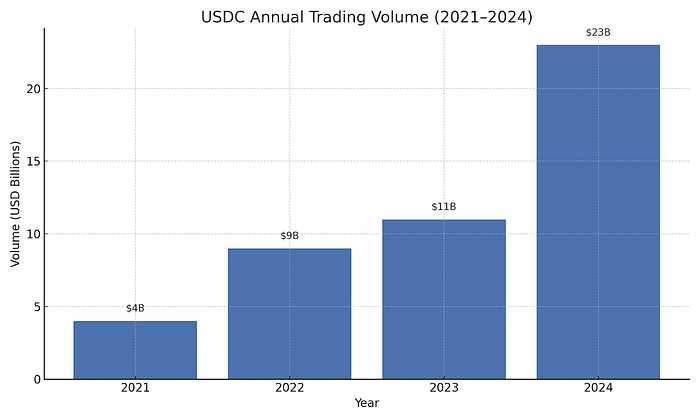
- USDC recorded $23B trading volume in 2024 — more than double compared to 2023.
- Exchange-centric activity now represents ~90% of total USDC volumes, driven by institutional and pro-trader use.
Takeaways:
- Strong liquidity pump — Daily trading in multibillions supports active use across exchanges and DeFi platforms.
- High transfer throughput — On-chain flows indicate institutional and retail demand beyond simple trading.
- Maintained peg and trust — Large, consistent volumes reflect sustained confidence post-peg event.
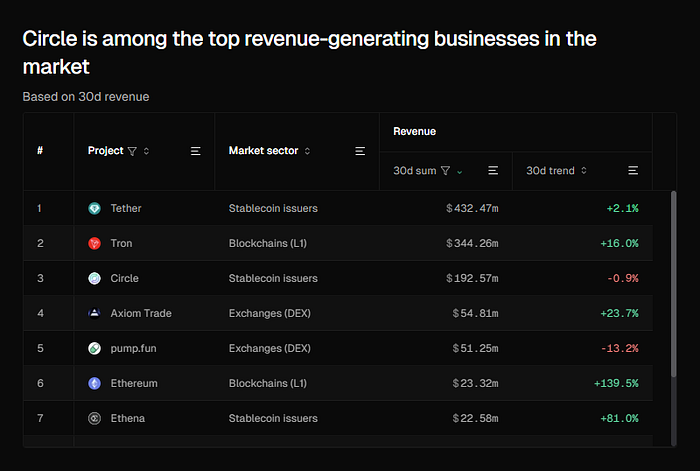
7. The Competition
Tether dominates in Asia and emerging markets, but Circle holds the edge in:
- Regulatory clarity
- Institutional trust
- Western financial integrations
If stablecoins win in the U.S. and Europe, Circle wins.
https://tokenterminal.com/explorer/studio/dashboards/98e3128c-502d-42da-8396-b7539ece9581?
8. Catalysts
- Rising regulatory pressure on Tether
- Big Tech adoption of stablecoins
- U.S. anti-CBDC sentiment boosts private stablecoins
9. Risks & Thesis Invalidation
1. Margin Compression from Distribution Costs
Circle’s core revenue — interest on USDC reserves — is eroded by significant payouts to distribution partners, especially Coinbase. In 2024, over 60% of revenue was shared, with Coinbase alone accounting for ~$800M annually. This structural revenue-sharing model limits Circle’s ability to expand margins despite strong top-line growth.
2. Sensitivity to U.S. Interest Rates
The majority of Circle’s income comes from yield on short-term Treasuries and repo markets. A decline in Fed rates would directly reduce gross revenue. While Circle argues that lower rates stimulate stablecoin usage, the offsetting fee-based services business remains nascent.
3. Increasing Competitive Pressure
The stablecoin landscape is becoming increasingly saturated. Tether continues to dominate ($154B supply), while Paxos, fintechs, and banks — including those developing proprietary stablecoins — threaten Circle’s distribution.
4. Regulatory Risk Shifts
While U.S. legislation may favor Circle, international frameworks remain uncertain and could limit global expansion.
Thesis Invalidation Triggers:
- Significant Fed rate cuts without equivalent growth in fee revenue
- USDC fails to achieve adoption beyond exchanges
- Disruption by new entrants (banks, Big Tech, sovereign-backed stablecoins)
- Regulatory momentum shifts away from Circle’s model
10. Final Take
Circle is no longer a speculative crypto play. It’s a publicly traded, revenue-generating infrastructure layer for digital dollars.
In a world where Big Tech and TradFi converge with blockchain rails, Circle sits at the intersection of it all.
It’s regulated. It’s cash-rich. It’s profitable.
And now, it’s investable.
Sigil invested at a $5B FDV valuation pre-IPO.
Disclaimer: This is not financial advice. Always do your own research before making investment decisions.