
In 2024, Sigil Stable delivered a net return of +35.12% with a Sharpe ratio of 2.54. Even more impressively, it finished every single month of the year in positive territory. These are hedge-fund-level results and they came without betting on bull markets or taking on heavy directional risk.
How is that possible?
The answer lies in a part of portfolio construction that often gets overlooked: market-neutral strategies. These strategies aren’t built to shine during risk-on rallies. They’re designed to quietly compound, minimize drawdowns and stay resilient when volatility hits.
In this article, we’ll explore how sophisticated investors build portfolios that can perform across market cycles, where market-neutral strategies fit into that puzzle and how Sigil Stable provides a crypto-native take on this approach.
The building blocks of a portfolio
Professional investors don’t just chase returns, they also manage risk, correlation and liquidity. The goal is to combine assets in a way that works over the long run, not just in bull markets.
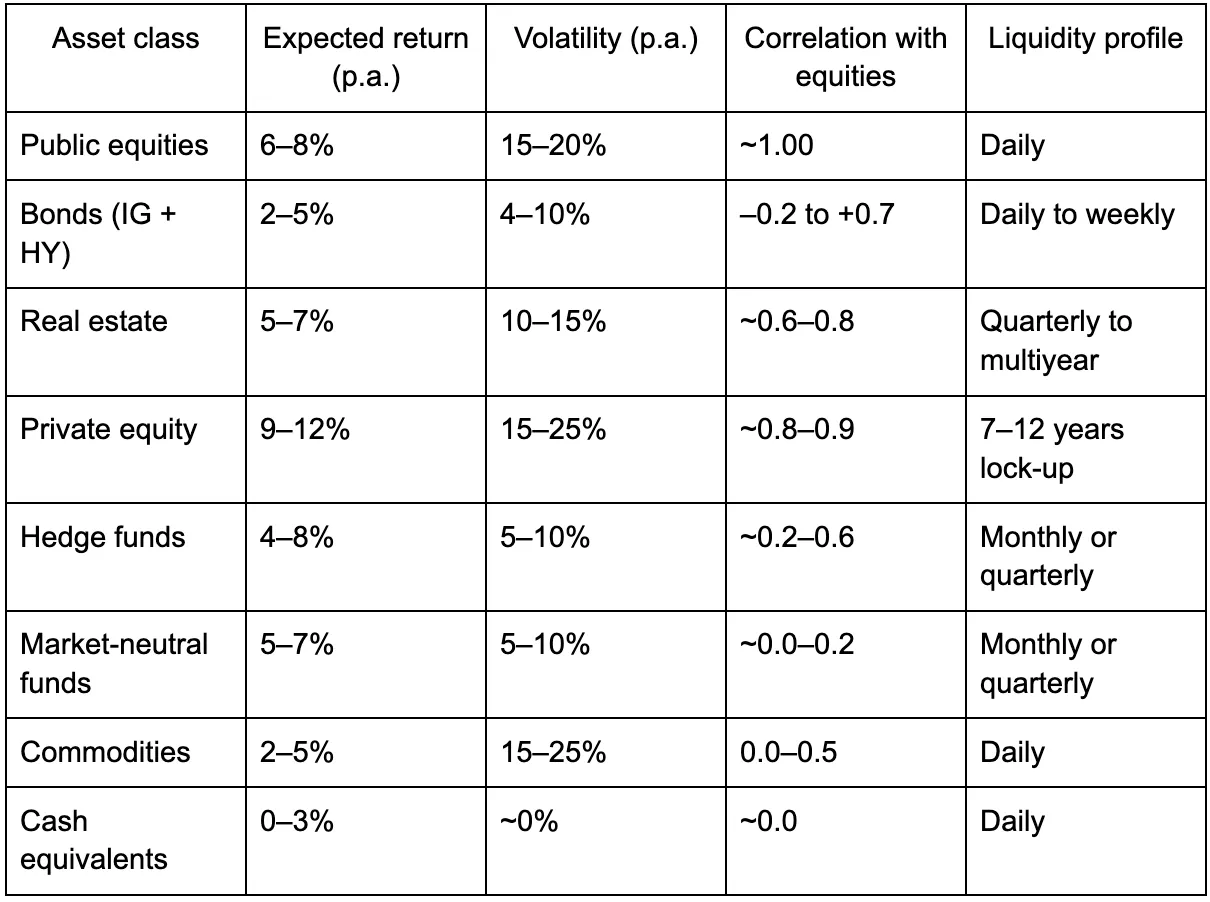
Here’s a simplified overview of how different asset classes compare on those core metrics:
Why correlation matters — and why it’s getting harder to escape
Correlation shows how closely one asset moves with another. It’s measured using the Pearson coefficient, which ranges from:
- +1.0 = perfectly in sync
- 0.0 = no relationship
- –1.0 = perfectly opposite
Low correlation across your portfolio has long been a go-to tactic for reducing risk and boosting risk-adjusted returns.
But here’s the problem: in recent years, correlations between asset classes have been rising.
- According to FTSE Russell, the relationship between equities, bonds, and credit tightened sharply after COVID — a sign that the old diversification playbook might be losing its edge
- The long-term correlation between US stocks and medium-term Treasuries jumped from around –0.30 (2000–2020) to +0.62 from 2021 to 2024
- Morningstar reports that stock–bond correlations stayed above +0.5 through 2022–2024, mostly due to high inflation and synchronized central bank policy
- Vanguard and others have warned that the classic 60/40 portfolio isn’t as reliable as it once was
What does that mean in practice? It’s getting harder to find assets that truly zig when others zag. And that’s exactly where market-neutral strategies come in.
What market-neutral strategies do (and don’t do)
Market-neutral strategies aim to generate returns without depending on which way the market moves. Instead of betting long on a sector or asset, they take both long and short positions to isolate specific inefficiencies — such as mispricings or funding rate gaps.
Their job in a portfolio isn’t to drive flashy gains. It’s to add a layer of stability. Institutions use them to lower volatility, smooth out drawdowns, and build in some protection for choppy markets.
These strategies show up most often in:
- Endowment-style portfolios
- Risk-managed mandates
- Alternative sleeves where consistency matters more than headlines
They require skill and infrastructure to execute well but for investors willing to deal with a bit more complexity, they’re powerful tools.
Traditional market-neutral strategies: proven but crowded
Market-neutral strategies have been around since the 1930s. They became more systematic in the 1980s and 1990s with the rise of quant investing.
Some standout examples include:
- AQR Equity Market Neutral (QMNIX): ~6.7% annualized returns, Sharpe around 1.8–1.9
- Renaissance Medallion Fund: ~39% annualized over three decades, with a Sharpe ratio estimated above 2.0
Endowments like Yale and Harvard have long allocated a sizable portion of their portfolios to strategies like these, often 20–25% or more.
The downside? These funds are usually off-limits to individual investors. Minimums can run into the millions and access is tightly controlled.
In crypto, market-neutral is a whole new game
Crypto’s market-neutral strategies are newer but they come with fresh opportunities. Because crypto markets are still fragmented, inefficient and evolving, there are more edges to be found.
Strategies can include:
- Arbitrage across centralized and decentralized exchanges
- Funding rate capture
- Basis trades
- Yield farming with hedging
- Airdrop strategies
- DeFi-native relative value
These would be nearly impossible in traditional finance due to regulation or lack of infrastructure.
Crypto’s edge lies in flexibility and speed. But it’s not without risk like smart contract bugs, platform failures and regulatory shifts all matter. Still, some crypto-native market-neutral funds have delivered Sharpe ratios above 2.0, competing with the best in TradFi or even outcompeting them.
Where Sigil Stable fits
Sigil Stable is built to deliver steady, uncorrelated returns in the crypto space. It’s not about hype or moonshots, it’s about consistency and control.
Over the past 30 months (01/2023–06/2025), Sigil Stable has posted gains in 29 out of 30 months, with a total net return of +70.10% and a Sharpe ratio of 2.28. That puts it at the high end of global market-neutral strategies. More than 50% of the capital is our own, so alignment is built in from day one.
We don’t chase narratives. We focus on capturing inefficiencies with discipline, repeatability and robust risk management. Years of iteration and calm decision-making across multiple crypto cycles have shaped what Sigil Stable is today.
For investors seeking exposure to crypto without taking on full market risk, we believe Sigil Stable offers a reliable and proven path.
What’s next?
In the next article, we’ll walk through the specific market-neutral strategies we use at Sigil Stable, how we find opportunities, manage risk, and operate in practice. Stay tuned.
Find out more about Sigil Stable here or apply to join.