
Dear Investors,
The first quarter of 2023 was eventful, much like the entire year of 2022. It appears that crypto markets hit their bottom in the previous year. This year so far the markets have been moving sideways with a slightly positive bias. That’s what we call a consolidation phase of the market cycle — usually a good investment opportunity to enter. Some volatility can be expected throughout the year, especially in light of the ongoing banking crisis. Macro environment stopped being hostile and is not expected to bring more negative news for the crypto markets. However, we are witnessing intensified attacks on crypto from the SEC and other US institutional bodies. Let’s dive into the details.
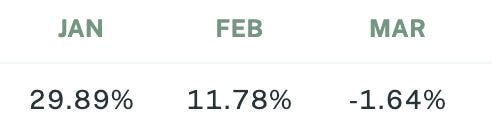
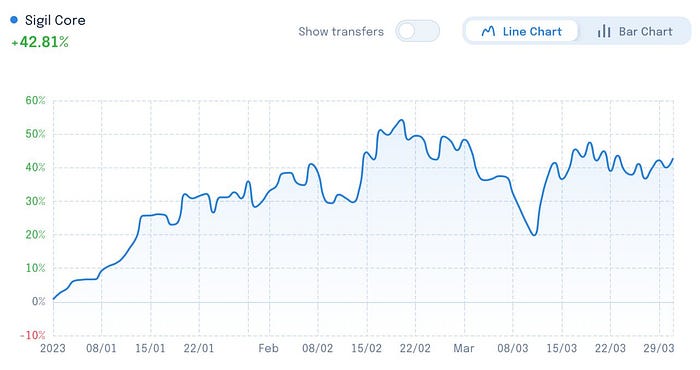
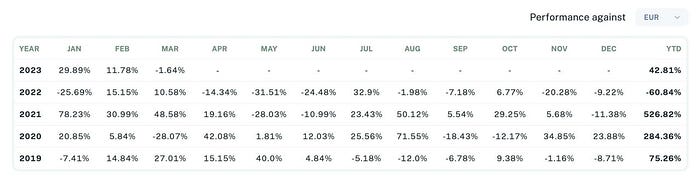
In the Q1 of 2023, Sigil Core recorded +42.81% vs EUR, +44.69% vs USD, -16.10% vs BTC.
Sigil Core Net Performance vs EUR Q1 2023
Macro situation
In January, the FED announced a quarter-point rate increase following their meeting. This adjustment was the smallest since March 2022. Furthermore, the FED acknowledged that inflation had begun to meaningfully ease. The rate increase had little to no impact on the markets. However, after a lengthy period, both the crypto and stock markets began to show signs of improvement in January and February — in response to positive news about inflation. The prevalent opinion has been that the tightening macro storm is mostly over. FED policies are unlikely to surprise negatively going forward. Furthermore, a potential pivot in the FED policies could be a major growth catalyst. However, some of the investors were concerned that this positive mood could be just temporary and could lead us into the repeat of the “echo bubble” that occurred in 2019:
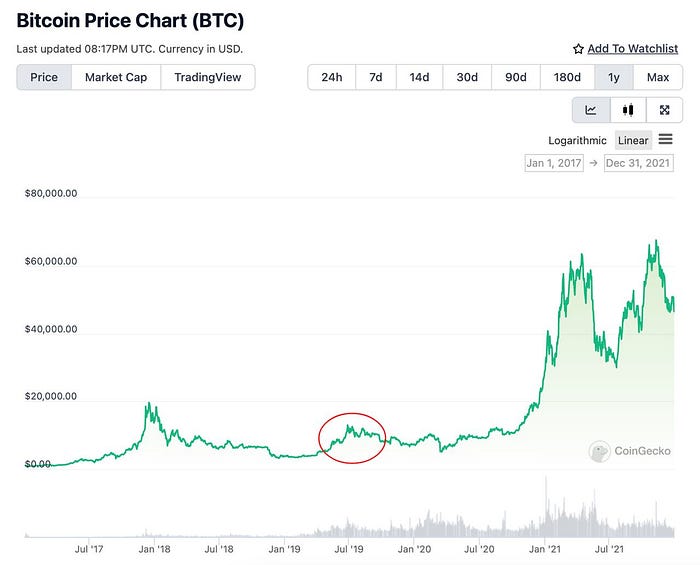
In March we saw bankruptcies of three major US banks, namely Silvergate Bank, Signature bank and Silicon Valley Bank. All of them had a substantial exposure to cryptocurrency customers or the tech start-up industry. It’s worth noting that these failures were not caused by the crypto exposure. They were triggered by the mismanagement in bank balance sheets (funds locked in government bonds for the long term and their value falling as the interest rates increased), the classic bank run and the following contagion. This created a ripple effect that shook the markets. Deutsche Bank experienced difficulties with its shares dropping by over 14% at one point, although not as severe as the situation faced by Credit Suisse. Agreement by UBS to take over Credit Suisse in an all-share takeover followed, with Credit Suisse valued at $3.2 billion.
The US Federal Reserve raised interest rates again in March by 0.25 percentage point, despite concerns that such a move could deepen the financial turmoil that followed a series of recent bank failures. Also, the European Central Bank announced a 50 basis point increase in interest rates, along with a demonstration of its readiness to provide liquidity to banks in the event of any instability in the banking sector that might result from recent events.
Due to the joint effort of utilizing daily swap lines which are set to continue until at least the end of April, the Fed, along with the European Central Bank, Bank of England, Swiss National Bank, Bank of Canada, and Bank of Japan, was able to stabilize the situation by being prepared to provide liquidity. The Swiss government therefore provided UBS with a short-term loss guarantee and liquidity of $108 billion from the Swiss National Bank to take over Credit Suisse. Providing the markets with a liquidity supply naturally led to a boost in confidence and a subsequent stimulus. Sigil Core increased long exposure on the Fed swap lines news resulting in improved returns since then.
Careful observers can spot a few recurring themes in these policy decisions that are rather interesting:
- The FED seems to be very comfortable putting more pressure on the banking sector by hiking the rates further.
- All deposits in the failing banks are made whole, shareholders zeroed out and failed banks swallowed by a few bigger banks that are too big to fail (JP Morgan and the likes).
- All of this leads to a growing trend of centralisation (some call it even “nationalization”) of commercial banks. Reducing the number of banks could be a deliberate effort by the central bank in order to pave the way for CBDC (“Central Bank Digital Currency”) roll out in the near future.
- Meanwhile chair Gensler of the SEC keeps blaming the failure of the banks on their crypto exposure which is abundantly incorrect and makes it clear that the authorities are really worried about fiat money losing its status. The war on crypto has officially started. Meanwhile, more and more people put their faith in crypto currencies as fiat money and the banking sector keeps failing.
The impact of banking distress on crypto
Circle, a company that issues USD Coin (USDC) held $3.3 billion of its about $40 billion of USDC reserves in the failed Silicon Valley Bank (SVB). Therefore after SVB’s collapse, USDC lost its $1 peg, dropping as low as 86 cents. DAI, a stablecoin issued by MakerDAO, lost 7.4% of its value since USDC accounted for 51.87% of DAI’s collateral worth $4.42 billion.
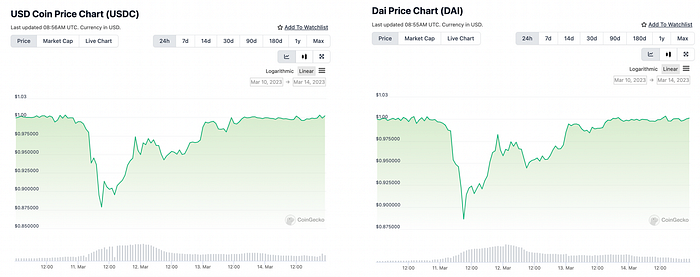
Investors faced the decision of where to relocate their funds from the exposed stablecoins. Some of them chose BTC or ETH as a safe haven, while others (including Sigil Core) took advantage of the opportunity for a profitable trade between stablecoins, particularly in terms of security, ironically to the USDT.
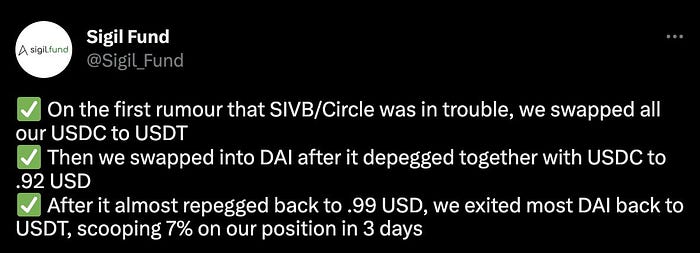
Stablecoins regained their peg as US federal regulators vowed to compensate all depositors, including those whose funds exceeded the Federal Deposit Insurance Corporation’s (FDIC) protection limit of $250,000. Sigil Core gained +7% on its stablecoin position in 3 days.
Following the intervention of regulators, the broader cryptocurrency market has experienced rapid growth, with BTC seeing a spike of up to 10% and surpassing the $22,000 mark.
The U.S. crypto crackdown
According to Gery Gensler, the chair of the U.S. Securities and Exchange Commission (SEC), most crypto products should be classified as securities. He has used this framework to charge several major crypto companies, such as Gemini, Genesis, and Kraken, with failing to register their financial products with the SEC since January. These companies offered yield programs that allowed investors to earn interest on their deposits.
Kraken has agreed to pay $30 million to settle charges filed by the SEC over its allegedly unregistered offering and sale of a program that provides staking-as-a-service for cryptocurrency assets. Meanwhile, Coinbase has submitted a petition to the SEC and has publicly emphasized that its staking programs are fundamentally different from those of Kraken. The Coinbase CEO Brian Armstrong has stated his willingness to defend this stance in court if needed.
The news of the SEC’s plan to target staking products caused a surge in demand for Liquid Staking Derivative (LSD) tokens like Lido’s LDO and Rocketpool’s RPL (about which we informed you in the previous letter to investors), and was further amplified when Kraken closed its US staking operation.
Gary Gensler testified before the House Financial Services Committee on April 18. If you want to see the amusing moment where he avoided answering whether ETH is a security or commodity, you can watch it here.
While the SEC is leading the charge against the crypto industry, other governmental agencies have also turned against it. The Federal Reserve, Federal Deposit Insurance Corporation (FDIC), and Office of the Comptroller of the Currency (OCC) issued a joint statement last week warning banks about the liquidity risks associated with stablecoins. In February, the White House released a statement warning about the risks associated with crypto.
In February, the New York Department of Financial Services (NYDFS) ordered Paxos - the issuer of the world’s third-largest stablecoin (Binance USD) to cease minting new units of the crypto token as it should have registered the product as a security. As a result, Paxos announced to end its relationship with Binance.
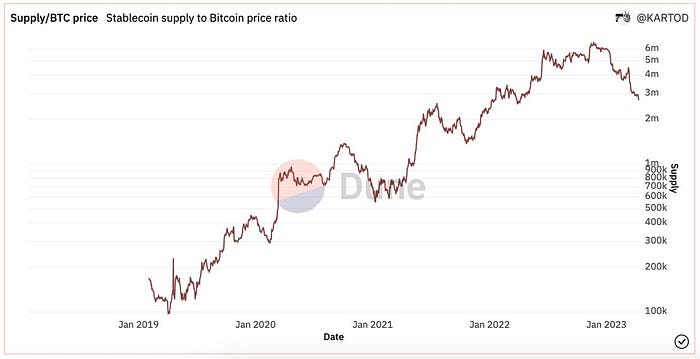
The threat of further regulatory action against stablecoins has prompted some capital to move into BTC and ETH.
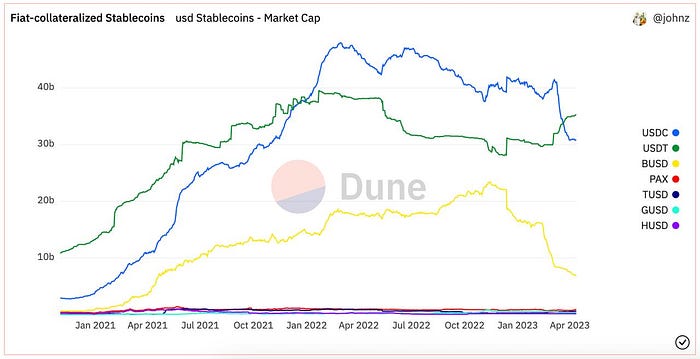
Furthermore, Binance’s CEO Changpeng Zhao and the cryptocurrency giant are facing legal action from the Commodity Futures Trading Commission (CFTC) for allegedly violating US trading and derivatives laws. Binance is being accused of having a compliance program that was “ineffective” and intentionally violating the law. Ironically, the value of the BNB token spiked after the news was announced.
Ordinals
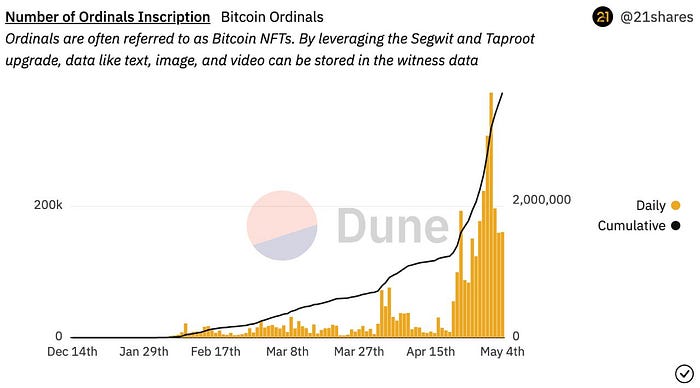
Bitcoin Ordinals are digital artifacts that allow digital content such as art to be inscribed on the BTC blockchain (imagine NFT on Ethereum, but a little bit different in the technical sense). Launched in January 2023 by Casey Rodarmor, the protocol offers an immutable on-chain presence for artwork, text or video. The hype around ordinals took off in February 2023, with inscriptions doubling weekly for a few weeks. The rise of Bitcoin ordinals has led to increased usage, fees, and storage space for the BTC network, marking a breakthrough for its application tier.
Long term, Bitcoin is facing security budget problems, since the network transaction fees appear to not be high enough to incentivize miners, as incentives in the form of newly mined Bitcoin decrease every four years. Ordinals are bringing new activity on the Bitcoin blockchain, increasing the fees and potentially solving the security budget problem.

The first created BTC Ordinal
ETH protocol ERC-4337: Account Abstraction
New on Ethereum since March is protocol ERC-4337 which makes it possible to transact and create contracts in a single contract account. It opens the door to user-friendly crypto wallet designs that could potentially facilitate broader adoption. Imagine the private key stored in a mobile using biometric identification to sign a transaction, which is used to sign for example Apple Pay transactions today. Visa already tested auto-payments or pull-payments with this protocol on StarkNet.
ETH Shapella (Shanghai + Capella)
Despite occurring on April 12, it is important to note the significant Shapella fork that allowed withdrawal for users who had “staked” their Ether (ETH) to validate and secure transactions on the blockchain. Similar to the transition from Proof-of-Work to Proof-of-Stake, this went smoothly with approximately 285 withdrawals processed in the first half hour after the upgrade was activated. As a result, the network has now completed its multi-year transition to a fully Proof-of-Stake network. The price of ETH increased roughly by 2.5%, reaching $1,927.
Vitalik Buterin, the co-founder of the Ethereum blockchain, said: “we’re in a stage where the hardest and fastest parts of the Ethereum protocol’s transition are basically over. Very significant things still need to be done, but those very significant things can be safely done at a slower pace.”
He also mentioned that making transactions faster and cheaper will be the next issue that the blockchain tackles after Shanghai.
The legalization of crypto in Hong Kong
Hong Kong has laid out ambitious plans to establish itself as a leading crypto hub in Asia by embracing digital assets and inviting investors. The government’s legislative framework aims to bring certain crypto service providers under the same regulatory regime as banks. This move is expected to boost the influx of capital from China into cryptocurrencies as Hong Kong takes steps to legalize the buying, selling, and trading of these digital assets.
Amid this news, we could observe the narrative surrounding China-based coins. These coins, which gained popularity in China due to various reasons, experienced a sharp price increase. However, as time has shown, they turned out to be just short-lived pumps and dumps. At least for now.
Parallel PRIME
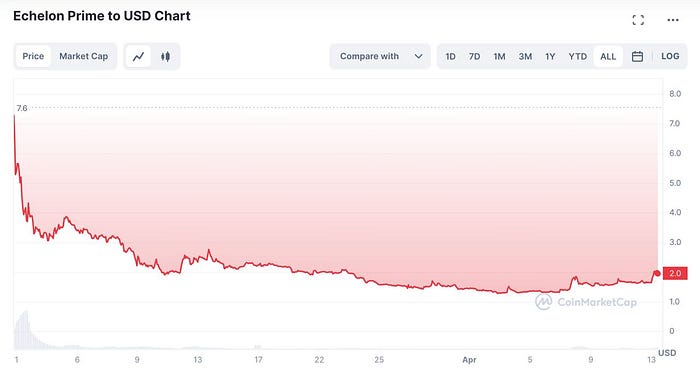
The long-awaited launch of the Parallel.life PRIME token finally took place on March 1. Sigil received 93,000 PRIME tokens through its investments in Parallel assets. We sold them at a hefty average price of approximately $6. PRIME is currently being traded under $2. It is often the case that token launches before the game is playable experience a peak-and-selloff moment in price:
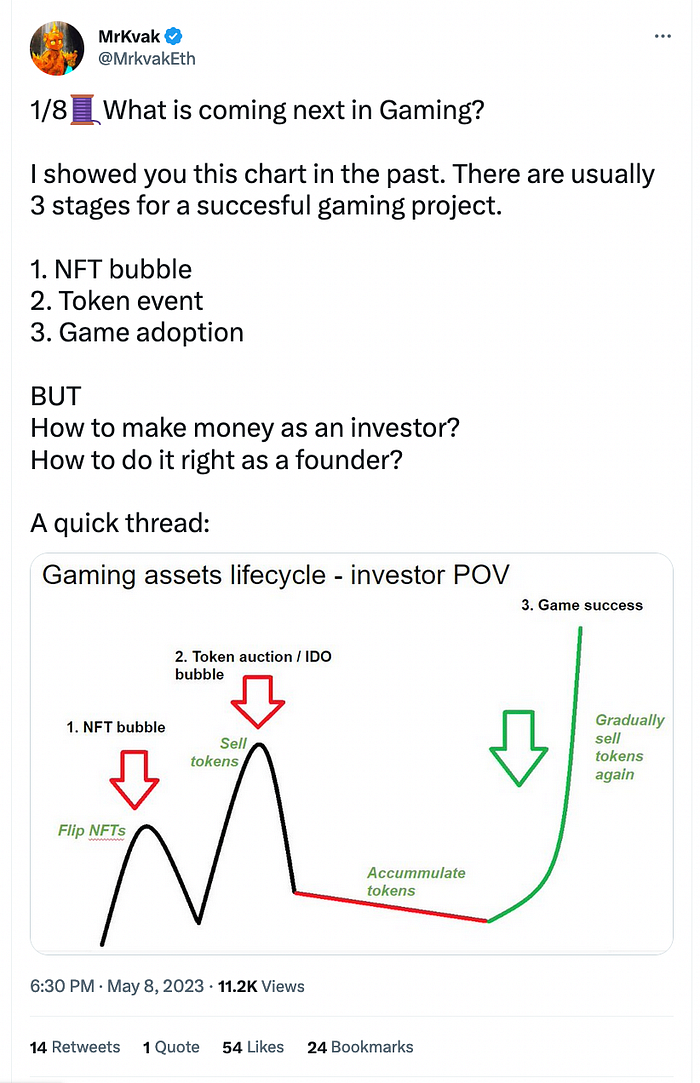
We expect this chart to be true for Parallel (and its PRIME token), too. We have been testing the game since the initial alpha product in September 2022 and continued active testing in the closed alpha stage in March 2023. The game is very promising. Next steps are closed beta in July and public launch of the game in Q4 2023. Meanwhile, Parallel is not just a card game, they sell multiple digital and physical items, art and lore collectibles such as comics, PFP avatars, weapon skins and digital companions. There will be more games in the Parallel universe thanks to their holistic approach and gradually expanding 3D library of items in the game engine.
We remain bullish on the Parallel ecosystem and will continue to receive PRIME tokens in the future due to our investments in productive Parallel assets and ParagonsDAO tokens (PDT), which both earn us PRIME tokens long-term.
Speaking of web3 gaming in general, our overall allocation in gaming tokens is still under 6% of the portfolio. There are only a few games with liquid tokens where we are strongly convinced about their quality of vision, team and long-term production capabilities. These games, like Parallel, will have big product launches this year. We will be watching these product launches and web3 gaming space very closely and seek to generate overperformance from the opportunities that emerge.
Some of the top web3 games have been in production since 2021 and can really bring a shift to the gaming market and be perceived as high quality games with innovative features of true ownership. These top games are aware that blockchain complexities must be abstracted away and mainstream users care only about fun games with easy onboarding.
Majors before alts
Starting from mid-March, the major cryptocurrencies have outperformed the market, with BTC emerging as the clear winner. A significant amount of capital has been moved into BTC to ride this wave, leading to a considerable portion of altcoins ending March with negative returns. These periods of “flight to majors” are nothing new, they happened in the past in uncertain times. The turbulent environment around banks, stablecoins and regulatory pressures have surely contributed. It resulted in Sigil’s relative underperformance against BTC in the past quarter.
However, if ETH continues to demonstrate impressive resilience compared to BTC after the successful Shapella fork, historically, such growth has been followed by a season of altcoin shift and rally.
Zee Prime III
We are excited to inform you that our Sigil PCC regulated fund umbrella has recently introduced its second regulated VC fund and in total fourth fund cell — Zee Prime III. ZP III is a venture capital fund investing in early-stage crypto projects, including private token sales, SAFTs and equities in crypto startups. ZP III marks the next step after the thriving Zee Prime II, which was launched in late 2021.
The aim is to operate as a flexible and crypto-agnostic venture capital fund. The target size for close-ended Zee Prime III is set at $35m, and we anticipate reaching this goal swiftly. To learn more about this opportunity, please feel free to reach out to Marta or Martin from our Investor Relations team.
As a Sigil Core investor you are aware of the synergies among our research teams. When we know the projects and teams from the early Seed stage rounds (from Zee Prime research) and understand the whole history of their token launches, it is much easier for Sigil Core to enter liquid markets with high conviction.
USD deposits and withdrawals
We are happy to announce that we have opened a bank account with the renowned Swiss bank Sygnum. This allows us to accept investors’ deposits and process withdrawals in USD fiat payment rails. It is also a part of our effort to expand and welcome US investors. ZP III has already begun accepting investments from US investors.
The path forward
“First they ignore you, then they laugh at you, then they fight you, then you win.” — Mahatma Gandhi
Last year crypto survived all kinds of pressures coming from the inside, many centralized players dissolving, going bankrupt (sometimes scamming users along the way) and taking crypto prices down with them. This year it seems crypto will need to survive pressures from the outside. The SEC and policymakers ruling via fear rather than clarity and banking off-ramps becoming tighter. However, distrust towards the banking sector could be another potential catalyst bringing more attention to unique capabilities of crypto assets. Maybe a transparent, immutable, trustless and accessible 24/7 store of value is not such a bad idea after all.
We expect crypto markets to be volatile until the end of the year with elements of consolidation, gradually up from the bottoms. It seems highly unlikely the markets will break the lows set last year unless another high impact black swan hits the world. In the short-term the banking crisis could always shake up the markets a bit more. However, it is hard to see how this can ultimately lead to anything other than more money printing which always pushes markets higher.
More traction in crypto markets is broadly expected next year. However, money printing and investors trying to front-run the opportunity (next bitcoin halving is in April 2024 and Ethereum Merge was last September) could always start the uptrend unexpectedly earlier. Speaking about traction, we are shifting our focus a bit more towards user facing applications and protocols that are crucial for mainstream adoption (gaming, social).
We closely monitor and remain partially allocated in key DeFi and middleware protocols, but we acknowledge it will be harder for these to capture and retain value due to open-source and highly competitive nature of crypto. Ultimately we see two dominant sustainable moats for value capture:
1. Applications and protocols which are able to capture end users with superior UX, USP and high switching costs. There are many contestants in this area, but most crypto protocols competing only with fees and token incentives won’t have much chance. We are constantly looking for innovative applications that will bring tens of millions of new users to crypto. It is possible some of the gaming or social apps will be such.
2. Base layer crypto protocols with native assets will gain monetary premium thanks to their utility and other properties that investors will value at premium. BTC, ETH and other native tokens of sovereign blockchains are potential contestants. The Ethereum ecosystem is currently leading the narrative and we remain largely invested in it.
Going forward our goal remains to give our investors the best exposure to all the important verticals of crypto while also forming independent theses and finding non-consensus opportunities that can lead to outperforming the general market.
Thank you for your ongoing trust in Sigil fund.