Dear Investors,
We are pleased to address you with this letter summarizing the third quarter of 2022 and the performance of the Sigil Fund over that period. As you may have noticed, we are happy to do so through the redesigned website we launched in September.
However, before we outline the events of Q3, let us briefly comment on the recent bankruptcy of FTX, which happened before we finalized this letter.
How was Sigil affected?
Sigil Core:
- Had 10% on FTX and withdrew everything in time on first rumours.
- Held a small (0.5%) position in FTT and was able to sell it for ca. $22 (after a penalty for instant unlock).
- Derisked into stablecoins (from 85% long crypto to 50%) and partially hedged with shorting.
Sigil Stable:
- Withdrew all liquid funds a day earlier apart from ca. 1.5% of the portfolio which we intended to use for highly profitable market neutral strategies that occurred during the event.
- Another approx. 3% of the Stable portfolio was stuck on FTX via an indirect investment to a third party (market neutral algorithmic strategy).
Thanks to the fast reactions of our team, we were able to mitigate the losses and were affected less than most industry players. We will provide broader commentary on the FTX/Alameda meltdown and its market impact in the Q4 letter.
Macro situation
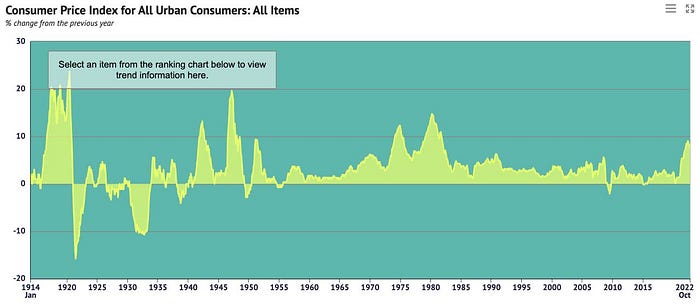
And now back to Q3: During this quarter, we could observe an ongoing struggle with high inflation. The US PCE inflation rate released by BEA for Q3 2022 was 4.2% on average. In this respect, the Fed had raised interest rates by 0.75% in September to a range of 3–3.25%. This represented the fifth rate hike so far in 2022.
Another significant event we witnessed in September was the BOJ’s almost $20 billion yen-buying, dollar-selling intervention. This moderated the Fed’s ongoing rate hikes at least slightly along with Chinese selling of the USD. The Japanese government still has $1.3tn in foreign reserves and BoJ continues with printing money.
Tornado Cash
In August, crypto faced a high-profile privacy threat. Popular Ethereum smart-contract mixer Tornado Cash was sanctioned by the U.S. Treasury Department’s Office of Foreign Assets Control (OFAC). Cryptocurrency mixers are used to anonymize crypto transactions by combining potentially identifiable crypto funds with vast amounts of others, and therefore also do not require Know Your Customer (KYC) checks. This could have stayed under the radar of US institutions as long as most customers were genuine users (crypto community). However, the protocol was allegedly used by North Korean hackers to launder over $800m from previous crypto exploits (Ronin bridge of Axie Infinity game and earlier DeFi hacks).
As a result the Tornado Cash protocol became a matter of national security and OFAC has banned all Americans from using Tornado Cash. Tornado Cash developer Alexey Pertsev has been arrested in Amsterdam and held in prison to date. Arresting a developer for committing a code into GitHub for an open source protocol surely violates personal freedom and the important principle that “code is speech”, so it will be curious to watch further developments in this case and see if there are any more reasons for the arrest.
On the regulatory front the Tornado Cash incident has led to development of further strategies and policies countering illicit finance in virtual currency and digital assets and releasing the Comprehensive Framework for Responsible Development of Digital Assets by the US Administration.
We believe that financial privacy is important for the ethos and value proposition of crypto and while Tornado Cash is being decapitated, in the future with Zero Knowledge technology getting into production, we expect many other privacy solutions to emerge, some of them offering selective privacy which can be more acceptable for authorities.
The Merge
Without a doubt, the positive highlight of Q3 was the Ethereum Merge, which we touched in the previous letter. This was a remarkable achievement as the first-ever transition from proof-of-work (PoW) to proof-of-stake (PoS). The smooth transition was almost surprising, since in crypto everyone expects something to go wrong at this point.
As a result, Ethereum’s inflation fell almost to 0% and in the near future with slightly higher usage Eth could even become deflationary. Also, the highly publicized energy consumption dropped by over 99% making Ethereum environmentally friendly.
We could observe the “good news is bad news” effect as the price of the ETH following the Merge dropped to $1250. This was caused mostly by the sell-pressure from miners selling their ETH holdings. Ethereum miners (using graphic cards) are now completely out of business which removes approximately $8b of annual sell pressure on Ethereum. We expect a delayed bullish effect similar to BTC halving but much stronger given the significantly reduced circulating ETH supply.
In layman terms Ethereum just experienced a reduction of supply comparable to “four Bitcoin halvings”. In the previous Bitcoin halving in May 2020 the annual inflation rate of BTC dropped from approx. 4% to approx. 2%. With the Merge Ethereum moved from 4% p.a. inflation to inflation rate between 0% to 0.5% (or even deflation in case of a high network usage in the form of gas fees). Those of you who understand the importance of Bitcoin halvings as a bullish catalyst for crypto markets will appreciate how major news this is.
The transition to PoS raised legal questions about whether ETH had become a security. Sigil team researched this topic thoroughly and is of the opinion it does not meet the legal criteria for a security.
Sigil Core’s strategy for the Merge was focused on extracting the value from ETH PoW forks and potentially acquiring staked ETH with a discount. However the most important play for us is to simply hold ETH in a way that maximizes yield, staking rewards or other forms of profit above the price appreciation. ETH is currently our largest position in Sigil Core fund.
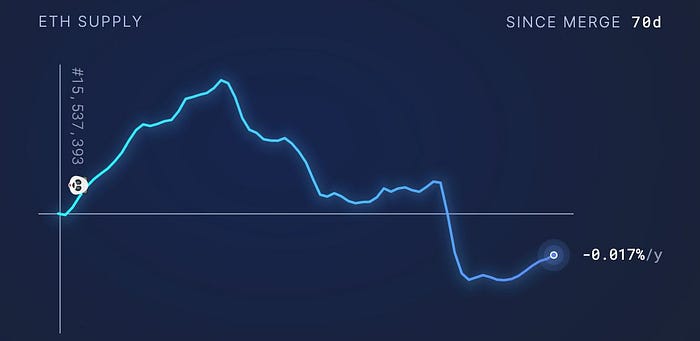
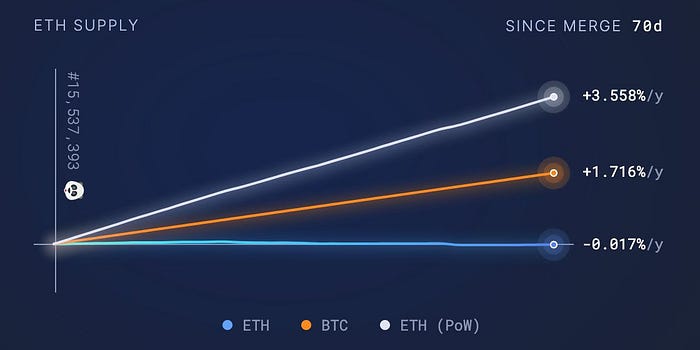
ETH supply dynamics after the merge (1st chart) and its comparison with ETH (PoW) and BTC (2nd chart). Source: https://ultrasound.money/
ATOM 2.0
The anticipated ATOM 2.0 white paper was released in September. ATOM, the Cosmos Hub’s native token, is intended to serve as a reserve currency. Mechanics utilizing liquid staking aims to accrue value for the token. Its issuance is also being reduced significantly. Along with this, other significant technological improvements were introduced.
From our point of view, this change somewhat missed the high expectations market had put on it, and while it will definitely increase ATOM value capture, we expect this effect to be reflected more in the long term, rather than immediately. We maintain a position in ATOM as one of the top contestants for app-chain thesis of blockchain scaling.
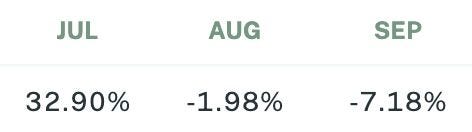
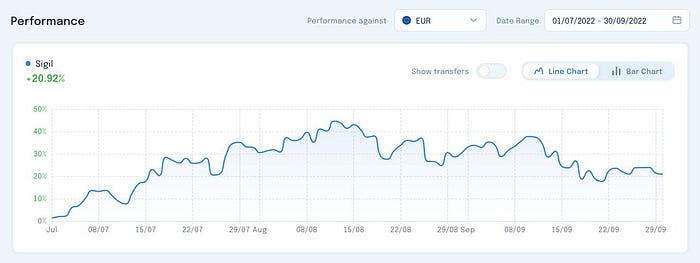
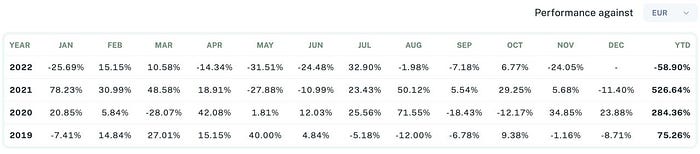
Sigil Core recorded a performance of: +20.92% vs EUR, +13.88% vs BTC in Q3 2022.
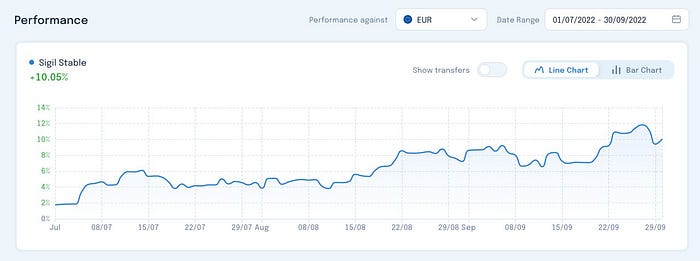
Sigil Stable recorded a performance of +10.05% vs EUR, +2.95% vs USD in Q3 2022.
Sigil Core Net Performance vs EUR Q3 2022
Sigil Stable Net Performance vs EUR Q3 2022